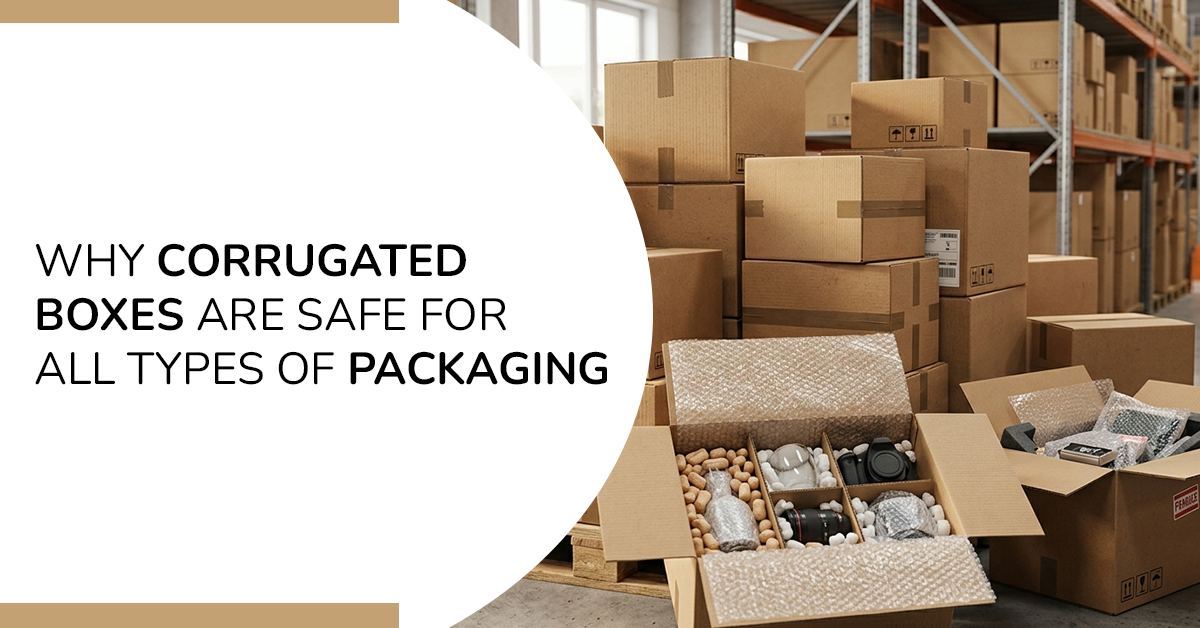
When businesses ship products, the packaging they choose says a lot about how seriously they take product safety. Corrugated boxes have been around for over a century, and there’s a reason they haven’t been replaced. They’re strong, they adapt to different product types, and they hold up under the stress that shipping and warehousing put on packaging daily. For industries looking for eco-friendly packaging solutions, corrugated boxes fit the bill too, since they’re made from renewable materials and can be recycled multiple times. Whether you’re shipping auto parts, electronics, or fragile glassware, working with a reliable Corrugated Box Manufacturers In Chennai gives you packaging built around what your product actually needs.
The Structure That Makes Corrugated
Boxes So Effective
What separates a corrugated box from a plain cardboard box is its internal structure. A fluted layer sits sandwiched between two flat linerboards, and that middle section acts as a cushion, absorbing shock and vibration during transit. Depending on the flute type (B, C, E, or combinations like BC), the box can handle different weights, stacking pressures, and impact levels.
This layered construction is what allows corrugated boxes to protect everything from heavy automotive components to lightweight consumer electronics. A single-wall box handles smaller, lighter items, while double-wall or triple-wall options give heavier goods the protection they need during long-distance transport. The ability to match box design to the demands of a product is why corrugated packaging remains the default across so many industries.
They Work for Practically Every Industry
The range of products that ship in corrugated boxes is wider than most people realise. A few examples from industries we work with regularly:
- Automotive and engineering: Engine components, machined parts, and heavy metal assemblies travel by road and sea inside reinforced corrugated boxes with custom die-cut inserts that lock each piece in place. Without those inserts, a single loose part can damage an entire shipment.
- Electronics: A circuit board that arrives with static damage is useless, and so is a cracked display panel. Corrugated boxes with antistatic liners deal with the static risk, while EPE foam inserts absorb the shocks that happen during loading, stacking, and last-mile delivery.
- Food and agriculture: A box of mangoes sitting in a humid truck for six hours will spoil if the packaging traps that moisture inside. Corrugated boxes coated for moisture resistance stop water from getting in, and the fluted walls create enough airflow to keep condensation from forming on the produce. That’s why most fresh produce logistics still run on corrugated.
- FMCG and e-commerce: The box is often the first physical thing a customer touches from your brand. If it shows up dented or torn, that impression sticks. Printed corrugated boxes with branded artwork hold up through courier networks and still look clean at the doorstep, which is why most D2C brands have moved to custom printed packaging.
- Aerospace and defence: The parts that go into aircraft aren’t just expensive, they’re regulated at every step of the supply chain. Multi-wall corrugated boxes with fire-retardant coatings are standard here because they meet FAA and ASTM packaging requirements while still being lighter and cheaper than metal crating.
A good carton box supplier will know which wall thickness, flute profile, and surface treatment to recommend based on the product, the distance, and how many times the box gets handled along the way.
Corrugated Boxes and Environmental
Responsibility
Most businesses today have sustainability targets in their procurement policies, and packaging is one of the first areas that comes under scrutiny. Corrugated boxes hold up well here because the raw material is paper pulp, sourced from managed forests and often containing 70-80% recycled fibre. Once a box has done its job, it goes back into the recycling stream and gets turned into new board.
This is where corrugated packaging fits into the eco-friendly packaging solutions that companies are adopting across their operations. Plastic sits in landfills for decades. Corrugated board breaks down within a few months. The energy required to produce it has dropped over the past two decades as manufacturers have upgraded to more efficient equipment and water-based adhesives. For businesses that need to show progress on waste reduction, corrugated boxes are one of the easiest wins available without sacrificing product protection.
Customisation That Matches Real-World Needs
Every product has different packaging demands, and the box that works for a 2 kg electronics module won’t work for a 25 kg engine casting. A packing carton box supplier who knows corrugated will start by looking at what you’re shipping, how far it’s going, and what kind of handling it’ll face along the way. Sometimes that means a regular slotted container is enough. Other times you need a half-slotted design for top-loading on the production line, or an overlap container where the extra flap coverage gives heavier items more stability during stacking.
Beyond the box style, there are customisation options that add to safety and functionality. Die-cut inserts and corrugated partitions keep products separated inside the box. Printed branding, barcodes, and handling instructions go directly on the surface. Moisture barriers, anti-corrosion liners, and fire-retardant coatings can be added depending on the application. Each one addresses a specific risk during storage, handling, or transit. A packing carton box supplier who understands your industry will know which options are worth the investment and which ones you can skip.
Strength Testing You Can Actually Verify
Corrugated packaging performance can be measured before a single product is packed. Manufacturers test boxes using bursting strength tests, which measure how much internal pressure a box can take, and edge crush tests, which simulate compressive force during warehouse stacking.
Tearing strength tests check how resistant the material is to ripping, which matters when boxes are handled by machinery or moved frequently. When a carton box supplier runs these tests in-house and shares the numbers, you know what the box will handle before it reaches a loading dock.
What Corrugated Packaging Costs
(and Why It’s Worth It)
Corrugated boxes don’t cost much per unit, and that gap widens at higher volumes. Paper pulp is one of the cheapest industrial raw materials around, and because the boxes ship flat, you’re not burning warehouse space storing empty packaging.
For companies that ship weekly or monthly, this adds up. You get packaging that protects the product without inflating your per-unit logistics cost, which is why corrugated remains the default for businesses running tight margins across automotive, electronics, and FMCG supply chains.
A Packaging Format That’s Earned Its Place
Corrugated boxes remain the most widely used packaging format in industrial and commercial shipping because they deliver on what matters: product protection, customisation, sustainability, and cost. They work across industries, they can be designed around virtually any product, and they’re backed by testing standards that give both shipper and receiver real confidence. If you’re looking for Packaging Companies In Chennai that can supply corrugated boxes tailored to your requirements, choose a partner with in-house manufacturing and the ability to scale as your packaging needs grow.