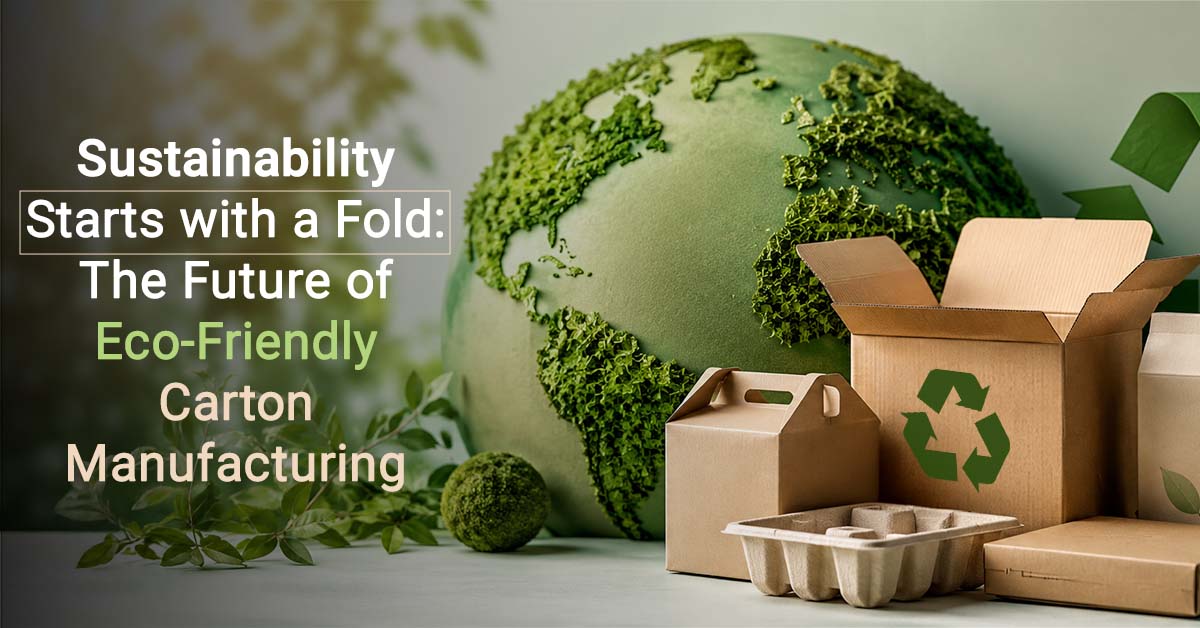
Sustainability Starts with a Fold: The Future of Eco-Friendly Carton Manufacturing
The packaging world is changing, and businesses that ignore it are falling behind. Consumers want greener choices. Regulators are tightening rules on waste. And supply chains are under pressure to cut their environmental footprint without cutting corners on protection. At the center of all this sits a surprisingly simple object: the carton box. Every reliable carton box supplier and carton box manufacturer in Chennai today is asking the same question: how do we build something strong, affordable, and sustainable?
The answer starts with a fold.
Why Carton Packaging Is the Sustainability Story
Worth Telling
Not all packaging materials age well under environmental scrutiny. Plastics face bans. Styrofoam is being phased out. But carton-based packaging keeps earning its place, because the material itself is part of the solution.
Here’s what makes carton boxes one of the most environmentally sound packaging choices available today:
Carton boxes come from wood pulp, which grows back. They recycle cleanly and re-enter the supply chain as new board. When recycling isn’t possible, they break down without leaving microplastics behind. And because they’re light relative to what they carry, you’re burning less fuel per shipment without changing anything else about your logistics. Four real advantages, no greenwashing required. For industries that ship in volume (automotive, electronics, FMCG, e-commerce) switching to well-designed carton packaging is one of the fastest ways to reduce environmental impact without redesigning the whole supply chain.
What Eco-Friendly Packaging Solutions Actually
Look Like
The phrase “eco-friendly” gets used loosely. In practice, eco-friendly packaging solutions need to meet real performance benchmarks, not just look good on a sustainability report.
For carton boxes, that means:
- Structural efficiency A well-engineered box uses exactly as much material as the product needs. Over-engineered packaging wastes board. Under-engineered packaging fails in transit. Getting the balance right requires proper design tools and material knowledge, not guesswork.
- Recycled content integration Many manufacturers now blend virgin and post-consumer recycled fibre in their board. The resulting boxes meet strength requirements while keeping virgin material consumption lower. This is the kind of closed-loop thinking that separates genuine eco-friendly packaging from greenwashing.
- Eliminating unnecessary coatings Laminated or wax-coated boxes can’t be recycled. Where these coatings aren’t essential for moisture or contamination resistance, removing them makes the box far easier to process at end-of-life.
- Right-sizing Oversized boxes filled with filler material (bubble wrap, foam peanuts, paper padding) defeat the purpose. A box designed to fit the product snugly reduces total waste across the packaging system.
Working with a supplier who thinks about all four of these dimensions isn’t just good environmental practice. It’s smart business.
The Role of Corrugated Box Manufacturers in the
Green Shift
Corrugated packaging is already one of the most recycled materials in the world, and corrugated box manufacturers are increasingly the ones driving sustainable innovation from the inside out.
The corrugated structure itself is an engineering achievement. Three layers of paper (two flat outer liners and a fluted inner layer) create a material that punches well above its weight in terms of strength-to-mass ratio. That means:
- More product protection per gram of material
- Better stacking strength for warehouse storage
- Reduced breakage rates, which cuts the hidden environmental cost of damaged goods
Progressive corrugated box manufacturers are pushing this further by:
- Sourcing board certified by the Forest Stewardship Council (FSC), ensuring the paper comes from responsibly managed forests
- Adopting water-based inks instead of solvent-based ones for printing and branding
- Using glue and adhesives that don’t contaminate the recycling stream
- Running manufacturing lines that reduce trim waste and reclaim offcuts
The result is a packaging product that performs well on the shelf and at the recycling facility.
The 3R Framework: Reduce, Reuse, Recycle
At Total Packaging Solutions, sustainability isn’t a marketing checkbox. It’s built into the product philosophy. The company operates on the 3R principle: Reduce, Reuse, Recycle.
Reduce means designing packaging that uses only what’s necessary. Thinner walls where the product allows. Optimised flute profiles. No excess void-fill.
Reuse is where corrugated packaging genuinely surprises people. With the right construction, carton boxes can handle multiple transit cycles. For industries like automotive and electronics, where the same parts move repeatedly between supplier and assembler, reusable corrugated packaging cuts both cost and waste significantly.
Recycle closes the loop. Corrugated fibre is accepted at virtually every recycling facility. It re-enters the paper supply chain and becomes the board for the next generation of boxes. This circularity is rare in packaging and deeply valuable.
Applied consistently, these three principles mean that every fold in a carton box represents a deliberate decision, one that considers the product, the journey, and what happens after delivery.
Industry Sectors Leading the Eco-Packaging Shift
The push for greener carton packaging isn’t coming from one place. E-commerce brands are cutting oversized boxes after customers started calling it out publicly. Automotive suppliers to Hyundai, Yamaha, and Royal Enfield have sustainability clauses written into their contracts. Food packaging is under growing regulatory scrutiny. Electronics manufacturers are replacing all-plastic packaging with corrugated boxes and EPE foam inserts that actually go into the recycling bin. Every sector has a different reason. The pressure, though, is pointing in the same direction.
What to Look for in a Sustainable Carton Packaging
Partner
Most businesses treat packaging as a procurement decision. They compare prices, pick the lowest quote, and move on. That works until something fails in transit, or a client starts asking questions about your sustainability credentials, and you realise you don’t actually know what’s in the box you’ve been shipping in.
A few things worth checking before you commit to a supplier:
- In-house manufacturing: Does the supplier actually make the board, or are they buying and reselling it? Manufacturers who control their own production catch quality issues before the box reaches you.
- Willingness to test: Any serious supplier will send samples and test them against your product’s load and transit conditions before a full run. If they skip this step, you’re the one absorbing the risk.
- Material honesty: Ask what percentage of the board is recycled content and where the rest comes from. A straight answer is a good sign. Vague talk about “sustainable sourcing” usually isn’t.
- Order flexibility: Eco-packaging shouldn’t only be accessible to companies ordering at scale. If a supplier won’t work with you at lower volumes, that’s worth knowing upfront.
The Fold That Changes Everything
A carton box is a folded sheet of engineered paper. That’s it. No complex materials, no difficult end-of-life processing. When the job is done, it goes into the recycling bin, gets broken down, and comes back as the next batch of board.
This simplicity is exactly what makes carton packaging worth taking seriously as a sustainability choice. It doesn’t require a separate disposal stream or specialist handling. It works with existing infrastructure, which means the environmental benefit isn’t theoretical, it’s happening every time a box gets collected. Total Packaging Solutions has spent over two decades building corrugated and carton boxes for industries that don’t have much patience for packaging that underperforms. Clients like Royal Enfield, Hyundai Mobis, and Yamaha set demanding specifications. The products have to hold up through actual supply chains, not controlled conditions.
If you want packaging that does its job without creating a disposal problem at the other end, get in touch with one of the most experienced packaging companies in Chennai and start with what your product actually needs.