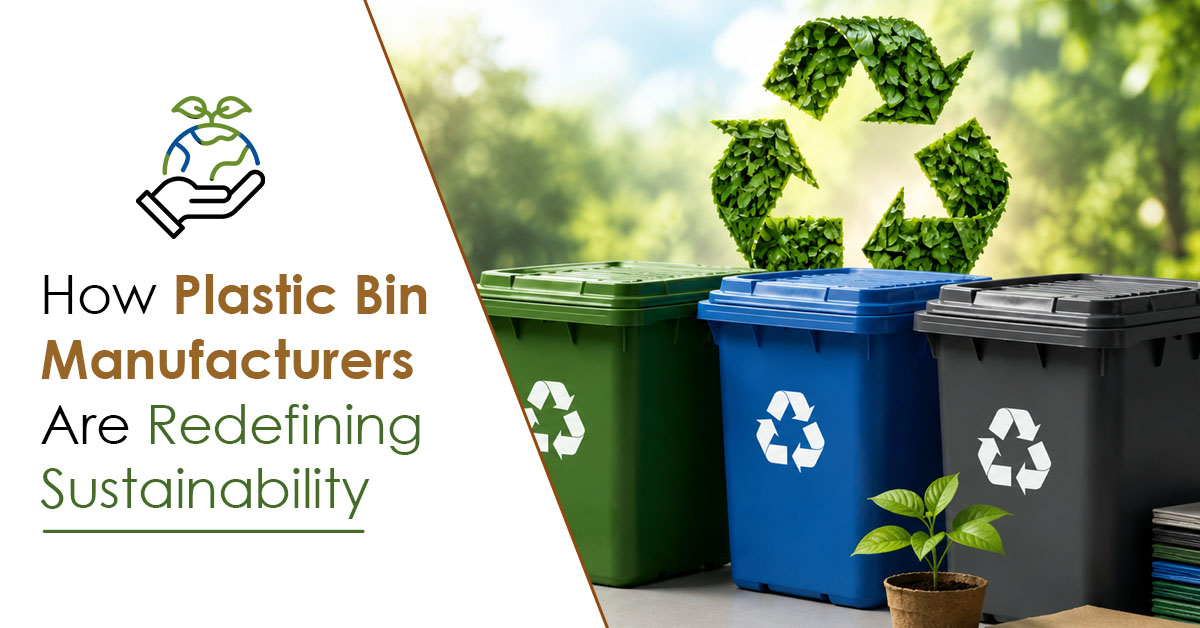
Packaging rarely gets credit for the role it plays in a company’s sustainability story, but that’s changing. Procurement teams are asking harder questions, audits are going deeper into the supply chain, and the materials a business chooses to store and ship with now show up in annual reports. For industrial buyers, that shift has put plastic bin manufacturers in Chennai under fresh scrutiny, and the better ones are responding with more than just better products.
This isn’t about greenwashing or adding a sustainability badge to a product catalogue. The changes happening at the manufacturing level are structural, measurable, and directly relevant to procurement teams, warehouse managers, and operations heads who want their packaging decisions to mean something beyond the bottom line.
The Old Perception vs the New Reality
Plastic has a reputation problem, and much of it is deserved. Single-use plastics, poor waste management, and a throwaway culture have left a genuine mark. But industrial plastic bins sit in a different category entirely, and it’s worth being clear about that distinction.
A heavy-duty polypropylene bin used in automotive parts logistics isn’t comparable to a disposable bag. These are products built for hundreds of cycles, designed to carry significant loads, resistant to moisture and chemicals, and repairable when damaged rather than immediately discarded. The sustainability case for well-manufactured industrial plastic bins rests on that durability, and manufacturers are now building on it intentionally, not incidentally.
What Sustainable Plastic Manufacturing Actually
Looks Like
Sustainable plastic manufacturing is not a single practice. It’s a combination of decisions made at the design, materials, and production stages, and at end-of-life. Here’s what that looks like in practice:
1. Using Recycled and Recyclable Raw Materials
Leading manufacturers now source polypropylene (PP) and high-density polyethylene (HDPE) that contain a percentage of post-industrial recycled content. The resulting product performs comparably to virgin material in most industrial applications and significantly reduces the carbon footprint of production. At the same time, products are designed to be fully recyclable at the end of their service life.
2. Designing for Longevity, Not Replacement
The greenest bin is one you don’t have to reorder. That means building for consistent wall thickness, chemical resistance, and load tolerance from the start. A bin running five years on a factory floor instead of two doesn’t just save money; it removes an entire production and disposal cycle from the equation.
3. Reducing Material Without Reducing Strength
Less material doesn’t mean weaker product. Smarter rib structures and tighter thickness control let manufacturers produce bins that are lighter than older versions, cutting transport emissions, without compromising on what they can carry or how long they last.
4. Returnable Packaging Systems
One of the most significant shifts in the industry is the move toward returnable and pooled packaging systems. Rather than single-trip disposable packaging, manufacturers now supply bins that travel back and forth between supplier and customer, sometimes hundreds of times. This closed-loop model dramatically reduces waste, lowers per-unit packaging costs over time, and keeps materials in use for as long as possible.
5. Minimising Production Waste
Scrap doesn’t leave the building. Offcuts, rejected sheets, and trimmed material get reground and fed straight back into production. It’s a simple practice, but it keeps the material loop tight and waste bills low.
Why Industrial Buyers Should Care About This Shift
The sustainability conversation isn’t just an environmental one anymore. When businesses choose their plastic bin suppliers, they’re making a call that shows up in cost sheets, compliance reports, and supplier audits down the line.
A few reasons it matters practically:
- Total cost of ownership: Unit price isn’t the full story. A bin that holds up for five years costs less than a cheaper one you replace every two, once you factor in procurement, downtime, and disposal.
- ESG and compliance reporting: Packaging shows up in sustainability audits whether you plan for it or not. Sourcing from suppliers with traceable, responsible practices makes that conversation easier.
- Supply chain resilience: Returnable systems cut reorder frequency, reduce storage pressure, and make procurement more predictable over time.
- Customer expectations: Questions about packaging are coming from buyers more often now. Having a clear answer is a commercial advantage.
The Role of Plastic Packaging Boxes in a
Circular Economy
Plastic packaging boxes, polypropylene corrugated boxes, danpla boxes, and returnable tote bins are workhorses of industrial packaging, and they fit a circular model better than most alternatives.
Cardboard degrades fast. A corrugated box might survive one or two trips before it needs replacing, and each new one draws on virgin fibre. A well-built plastic packaging box folds flat for the return journey, stacks cleanly when empty, washes down between uses, and can be repaired rather than binned when it takes a knock.
For sectors like automotive, electronics, FMCG, and engineering, where parts move repeatedly between supplier facilities and assembly lines, this reusability is not just an environmental benefit. It’s an operational one. A returnable tote system eliminates the constant procurement, storage, and disposal of single-trip packaging, replacing it with a managed asset that pays for itself over time.
What to Look for When Choosing a Supplier
Not every manufacturer making sustainability claims is backing them up with practice. When evaluating plastic bin suppliers, ask these questions:
- Do they offer products with recycled content, and can they verify it?
- Are their products designed to be recyclable at end of life?
- Do they have a returnable or pooled packaging programme?
- Can they provide in-house manufactured products rather than just reselling, which gives them greater control over material and production standards?
- Do they have direct experience across industrial sectors with varied handling and storage requirements?
These aren’t difficult questions to answer if a supplier is genuinely operating with sustainability built into their process. If the answers are vague, that tells you something too.
Total Packaging Solutions: Built for This Shift
Total Packaging Solutions, operating under the Chennai Polypack group with over two decades of experience, has been working with returnable packaging systems, in-house PP sheet manufacturing, and multi-sector industrial clients long before sustainability became a headline issue.
Their product range includes polypropylene boxes, returnable tote bins, plastic pallets, and a wide variety of primary and secondary packaging, all manufactured or carefully sourced with the 3R principles (Reduce, Reuse, Recycle) embedded into their approach. Serving clients from Royal Enfield and Hyundai Mobis to Yamaha and Daimler, they understand what high-volume industrial packaging actually demands: durability, consistency, and a supply partner who can manage the full loop.
If your packaging procurement needs to hold up to sustainability scrutiny, the starting point is a supplier who manufactures with intention, not just efficiency. Total Packaging Solutions is among the packaging industries in Chennai that has been doing exactly that, quietly and consistently, long before it became a selling point.
The Bigger Picture
Plastic bins and industrial packaging containers will not disappear from the supply chain, and there’s no environmental reason they should. The goal isn’t to eliminate them; it’s to make them better: longer-lasting, more responsibly manufactured, and part of systems that keep materials in productive use rather than sending them to waste.
Manufacturers who understand that are already doing the work. The question for industrial buyers is simply whether their suppliers are among them.