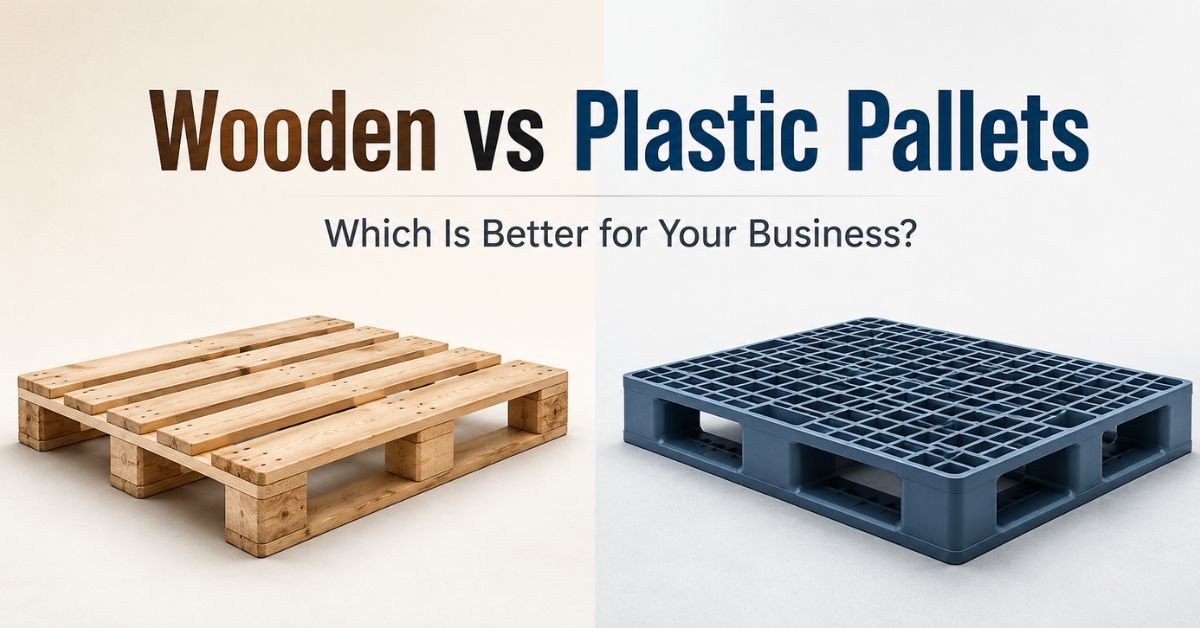
Every warehouse manager and supply chain team eventually faces this question. Your pallet choice affects how products are stored, how they travel, how much weight they take, and what they cost you over time. Neither option is universally better, but for most industrial operations in India today, the answer depends on a set of practical factors that are worth thinking through carefully. Whether you’re already buying from wooden pallet manufacturers in Chennai and wondering if plastic makes more sense, or setting up a new supply chain and weighing both options from scratch, the comparison is worth doing properly rather than going by habit or upfront price alone.
A Quick Look at How Each Pallet Is Made
Wooden pallets are built from sawn timber, hardwood or softwood, depending on load requirement, nailed or screwed together, and available in standard sizes like 1200 x 1000 mm or custom dimensions. The construction is straightforward, which is part of why they’ve held their position in the market for so long.
Plastic pallets are injection-moulded or roto-moulded from HDPE or polypropylene and come out as a single piece with no fasteners, no splinters, and no parts that can work loose. Plastic pallet manufacturers produce them across a wide range of load ratings, from light retail use through to heavy racking applications in industrial plants.
Where Wooden Pallets Still Hold Their Ground
Wood is still the majority choice for pallet procurement across India, and when you look at how most supply chains actually operate, that’s not surprising. A few reasons why it holds up:
- Cost at entry: Wooden pallets cost significantly less upfront than plastic equivalents. For one-way shipments or export use, this matters a lot. You’re not getting them back, so the economics of a longer-lasting material don’t apply.
- Load capacity and repairability: Wooden pallets handle substantial weight, and a cracked or broken board doesn’t mean the pallet is finished. Someone on the floor with basic tools can fix it in minutes. A damaged plastic pallet goes back to the supplier or gets binned.
- Custom sizes on short notice: Assembling timber to a specific dimension is far quicker and cheaper than commissioning new plastic moulds. For non-standard cargo or unusual racking setups, wood is the more practical option by a wide margin.
- Readily available everywhere: Whether you’re buying, getting repairs done, or disposing of old stock, the infrastructure around wooden pallets is well established across India at every scale of operation.
Wood does have a real limitation, though: it absorbs moisture. In food, pharma, and electronics environments, that creates genuine contamination and compliance problems that can’t simply be managed around. Export shipments add another layer, since ISPM-15 heat treatment is mandatory for international trade and not every supplier offers it.
The Case for Plastic Pallets
Plastic pallets have gained ground steadily among manufacturers, 3PLs, and exporters running closed-loop supply chains, and the shift makes sense when you look at where the costs actually land over time.
A plastic pallet doesn’t splinter, rot, soak up water, or attract insects. In pharma, food processing, and electronics, that isn’t just a convenience. It’s a regulatory expectation. The benefits of plastic pallets show up most clearly in returnable systems, where the same pallet goes back and forth repeatedly. Because it doesn’t degrade the way wood does, it can be washed, sanitised, and put back into circulation far more times before it needs replacing. Over a two to three year cycle, the per-trip cost often ends up lower than wood despite the higher purchase price.
Beyond the hygiene argument, plastic pallets offer a set of practical operational advantages that add up across a busy warehouse:
- Consistent dimensions every time: Every pallet from the same mould comes out identical. For automated handling lines and racking systems where even small size variations cause jams or load calculation errors, that consistency isn’t optional.
- No sharp edges or loose fasteners: Worker injuries from nail heads and product damage from splinters are both common with wooden pallets. Plastic removes both risks.
- Handles moisture and chemicals without degrading: Cold storage, wash-down areas, and chemical handling environments all suit plastic far better than wood.
- Can be tracked through the supply chain: RFID tagging is straightforward with plastic, which matters for operations that need visibility across a large pallet fleet.
- Washable and re-certifiable: A plastic pallet can be pressure-washed and returned to service. Wood absorbs contaminants and can’t be fully cleaned once it has.
Plastic makes less financial sense when the pallet is going out once and not returning. For one-way shipments, you’re paying for durability you won’t use.
Head-to-Head: How the Two Materials Compare
| Factor | Wooden Pallets | Plastic Pallets |
| Upfront cost | Lower | Higher |
| Lifespan | 3 to 5 years (with repairs) | 10 years or more |
| Repairability | Yes, on-site | No |
| Hygiene | Moderate | High |
| Moisture resistance | Poor | Excellent |
| Customisation | Easy and fast | Requires tooling |
| Best for | Export, one-way use, heavy loads | Returnable systems, food, pharma |
Durable Pallet Solutions for Specific Industries
Different industries have different priorities, and the pallet that works best for an automotive parts manufacturer won’t necessarily suit a food processing plant.
Automotive and engineering: Heavy parts, repeated forklift handling, and long racking cycles push these operations toward durable pallet solutions in plastic. Automated conveyor and AS/RS systems used in larger automotive plants also need the dimensional uniformity that moulded plastic delivers consistently.
Food and beverage: Once wood absorbs moisture in a cold storage or processing environment, it’s difficult to remediate and nearly impossible to certify as clean. Most food manufacturers who’ve dealt with a contamination audit have already moved away from it.
Pharmaceuticals: Cleanrooms and traceability audits set a high bar that wood can’t clear. Plastic pallets can be sanitised to the required standard and tagged for tracking, which is exactly what regulatory compliance in this sector demands.
Export and logistics: For one-way export shipments, wooden pallets remain the practical default. They’re cheaper per trip, ISPM-15 compliant options are well available, and there’s no case for investing in a more expensive pallet that won’t return. Where pallets do come back, durable pallet solutions in plastic make better financial sense across the full lifecycle.
E-commerce and retail: Lighter plastic pallets reduce handling strain, and the absence of protruding nails cuts down on product damage during picking, which is a real concern in high-velocity fulfilment centres.
So, Which One Should You Choose?
If your operation runs on one-way shipments, handles very heavy loads, or requires custom dimensions at short notice, wooden pallets are probably the right answer. The economics are straightforward, and the supply chain around them is reliable.
If your business runs a closed-loop supply chain, operates in a regulated industry, or uses automated handling systems, plastic pallets are likely worth the higher initial investment. The longer usable life, lower maintenance requirement, and hygienic properties offset the cost difference when pallets are in continuous rotation.
Many businesses find that the answer isn’t one or the other. A warehouse might use wooden pallets for outbound export shipments while running plastic pallets internally for in-plant handling and storage.
Getting the Right Pallet for Your Operation
Choosing the right pallet is a practical decision, not a theoretical one. The specifics of your load weight, handling frequency, industry regulations, and whether your pallets return or stay with the customer should all drive the answer.
Total Packaging Solutions, one of the long-established Packaging Companies in Chennai, supplies both wooden and plastic pallets, along with a full range of industrial packaging materials for the automotive, electronics, FMCG, and engineering sectors. If you’re working out which pallet type fits your operation, or looking for plastic pallet manufacturers for a returnable system, the team can help you think through the right option for your load requirements, handling setup, and supply chain structure. Get in touch to start the conversation.