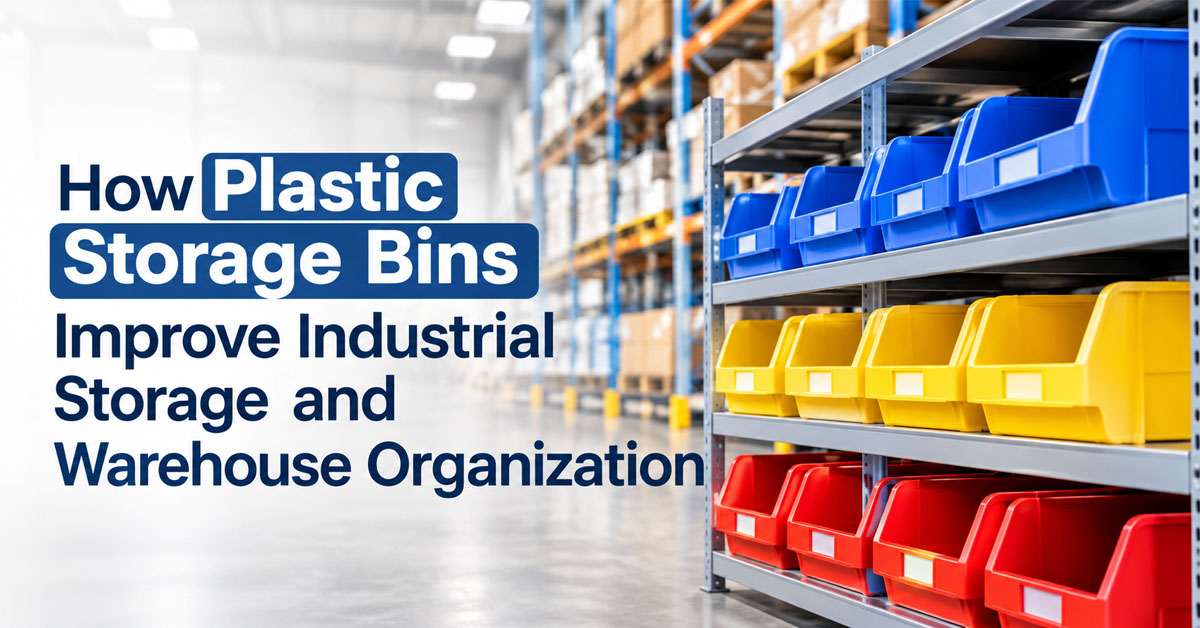
How Plastic Storage Bins Improve Industrial Storage and Warehouse Organization
Plastic storage bins give every part a fixed place, which reduces search time, handling damage and counting errors. Standard bin sizes stack evenly on racks and pallets, so you use floor space and rack height with less waste. Polypropylene and HDPE bins resist moisture, oil and repeated handling, and ESD bins protect electronic components from static discharge. Labelled bins support location-based picking, cycle counts and first-in, first-out rotation. At Total Packaging Solutions, we work as Plastic Bin Manufacturers In Chennai for factories, warehouses and distribution centres, and the same storage problems appear in almost every facility we visit. This blog covers those problems, the way bins correct them, the material and type to choose, and the questions to put to a supplier before you order. It starts with what unstructured storage costs you.
What Loose and Mixed Storage Costs Your Warehouse
Cartons, open crates and loose stock on pallets work until volume rises. Chennai’s humidity is hard on corrugated cartons, which lose stacking strength during the monsoon months and collapse at the bottom of a stack. Crates in mixed sizes leave gaps on racks. Operators then spend minutes searching for a part that sits two shelves from the location the system shows.
A stores team that verifies stock by opening containers loses hours on every cycle count. The cost appears in picking time, damaged parts and inventory accuracy. One misplaced part can hold up an assembly line until someone locates it.
How Plastic Storage Bins Organise Industrial Stock
Uniform sizes make racking predictable
Bins built to a standard footprint fit rack bays and pallet dimensions without gaps. When you plan shelves around two or three bin sizes, your stores team can calculate capacity before stock arrives. Stackable bins with a locking rim stay stable during forklift and trolley movement. Nestable bins slot inside one another when empty, so empties take up much less room in storage and on the return trip.
Labels and bin locations support accurate counts
Each bin carries a label, barcode or colour code. A part number on the bin, tied to a rack location in your system, lets an operator pick without asking anyone. Colour coding separates inbound, quality-hold and dispatch stock at a glance. Cycle counts become a count of bins.
Open-front and closed bins suit different picks
Open-front bins give operators direct access to small parts such as fasteners, bearings and fittings. Closed bins with lids keep dust off the contents and allow heavier stacking. Open bins on a dusty shop floor collect debris, and lidded bins on a fast pick line slow every operator who has to remove a lid.
Why Polypropylene and HDPE Suit Industrial Use
Polypropylene is light and stiff. It resists many oils, greases and cleaning chemicals, and it does not rust, rot or splinter. HDPE has higher impact strength, which suits heavier loads and rough handling on forklift routes. Neither material absorbs water, so the stock inside stays dry when the floor is washed down or a storage bay floods.
Electronics manufacturing needs a different grade. ESD plastic bins dissipate static charge and protect circuit boards, sensors and other sensitive components during storage and transfer between stations.
A returnable bin replaces many cartons over its service life, and a cracked bin is replaced alone.
Where Plastic Bins Work Across Industries
- Automotive and engineering units store fasteners, bushings and gaskets by part number in open-front bins on shelving.
- Electronics assembly uses ESD bins to move and hold components between stores and production lines.
- Spares and maintenance stores keep tools and replacement parts sorted by machine or department, so a breakdown does not start with a search.
- Warehouses and distribution centres use stackable bins for bin-level picking, which suits high-volume lines with many small items.
How to Choose the Right Bin for Your Facility
Bin selection works best when you follow a fixed order, and the rack comes first:
- Measure the rack bay depth, width and shelf height, and the pallet footprint if bins move on pallets.
- Weigh the heaviest typical load in each bin and compare it with the bin’s rated load.
- Match the bin type to the environment: open-front for fast picking, lidded for dust, ESD for electronics.
- Decide whether you need stacking, nesting or both.
- Confirm that the bin has a label holder or a flat panel for barcodes.
When you shortlist Plastic Bin Manufacturers In Chennai, ask for dimensions, load rating and material grade in writing, and request a sample to test on your own racks. A bin that fits the drawing but not the rack costs more than the delay it was meant to prevent.
Why Source Bins from Total Packaging Solutions
We supply HDPE and ESD plastic bins from Chennai, along with carton boxes, PP sheets and pallets, so your storage and dispatch containers can come from one supplier. When you share your bin dimensions, the load per bin and the storage environment, our team recommends a bin type and size and prepares a quotation against those details.
Send your requirements through the Request a Quote form or message us on WhatsApp.
Conclusion
Warehouse organisation depends on the container as much as the layout. Bins sized to your racks, labels tied to your system and a material suited to your environment give your team a storage setup that holds up through daily use. If you need to specify bins for a new layout or replace mixed containers on existing racks, send your rack dimensions and load details to us. Our team works as Polypropylene Box Manufacturers for Chennai’s industrial and warehouse buyers, and we will recommend a bin size and type with a quotation.
Frequently Asked Questions
How do plastic storage bins improve warehouse organization?
They give each item a defined container and a defined location. Stock stays sorted by part number, stacks stay stable, and operators find items from a label instead of memory. Counting is faster because you count bins and compare the total with your records.
Which is better for industrial bins, polypropylene or HDPE?
It depends on the load and handling. Polypropylene suits light to medium parts and clean, repeatable picking. HDPE takes impact better, so it fits heavier components and areas with forklift traffic. Tell us the heaviest part you store, and we will point you to the right one.
When do I need ESD plastic bins?
You need them whenever static discharge can damage the contents. That includes printed circuit boards, sensors, semiconductors and assemblies that go through electronics production. ESD bins release static charge in a controlled way.
How do I decide the right bin size for my racks?
Measure the usable shelf depth, width and height first. Then divide the shelf into whole bin units, with a small clearance for operator access. Two or three standard sizes across the facility keep rack layouts simple.
Can plastic bins carry heavy parts?
Yes, within the rated load of the bin. Load ratings depend on the wall thickness, the base design and the material. Weigh the heaviest filled bin in your operation and confirm it against the supplier’s stated rating before you place a bulk order.
How should I label and arrange bins for faster picking?
Print the part number and the rack location on each bin, and add a barcode if your system scans. Place fast-moving items at waist height near the aisle entrance. Keep slow movers on upper shelves, and use one colour for each stock status such as inbound, hold or dispatch.